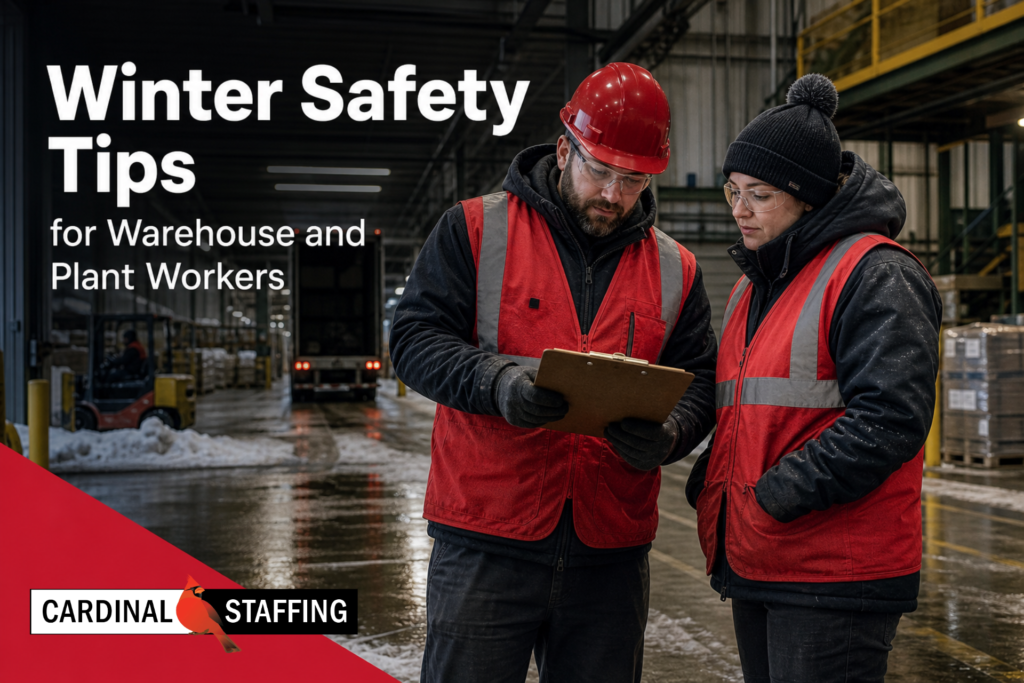
A wet entrance mat, a loading dock open to January wind, and a shift that starts before sunrise: that combination causes more winter incidents than any single piece of equipment. Winter changes the risk profile of a warehouse or plant from the parking lot to the production floor, and the hazards compound over the course of a shift. Snow gets tracked inside and melts into slick patches. Cold hands lose grip. Tired workers who drove in on icy roads start the day already behind on focus.
In our experience, nearly every winter incident traces back to a predictable cause: a wet floor nobody reported, footwear with worn soles, clothing that fit the commute but not the dock, or a rushed start on a cold machine. Predictable causes are preventable ones. This guide covers floors and walkways, cold stress, equipment handling, commuting, and what employers and staffing partners should do to keep a winter workforce safe.
Preventing Slips, Trips, and Falls on Wet Floors and Icy Walkways
Slips are the most common winter injury in industrial settings, and they cluster in the same places every season: entrances and exits, loading docks, ramps, stairwells, and the parking areas leading to them. Snow and ice ride in on boot soles and melt on smooth concrete, creating a thin film that looks harmless and isn’t.
Workers can reduce their own exposure with a few habits:
- Check your footwear before the season starts. Worn soles lose traction long before they look worn out. Replace boots with smooth or cracked treads before the first freeze, not after the first fall.
- Shorten your stride. Shorter steps with your weight centered over your feet give you far better balance on questionable surfaces.
- Keep your hands free. Carrying loads with both arms full means no way to catch yourself. Use carts where you can, and use handrails on every stair and ramp.
- Report wet spots and ice immediately. A patch that gets flagged can be cleaned, salted, or marked within minutes. A patch that gets walked around becomes someone else’s injury.
- Watch the transition zones. The step from a dry floor onto a wet mat, or from a mat onto bare concrete, is where footing changes without warning.
Mats and warning signs only work when they are placed correctly and maintained. A soaked mat stops absorbing moisture and becomes a slip surface of its own. If you see a mat that is saturated, bunched up, or missing from a known wet area, tell a supervisor or coordinator rather than assuming someone already has.
Cold Stress Prevention and How to Dress for a Shift
Cold stress is not limited to outdoor work. A dock with doors open all shift, an unheated warehouse, or a food processing area held at low temperatures can all push the body past what normal clothing handles. Early warning signs include numb fingers, shivering, fatigue, clumsiness, and slowed thinking. Those last two matter on a production floor, because a worker who is cold is a worker who is more likely to make an error with a tool or a load.
Dress in layers you can adjust, because conditions change between the dock and the production floor:
- Base layer. Moisture-wicking material against the skin. Cotton holds sweat and chills you once you stop moving.
- Insulating layer. Fleece or a similar mid-layer that traps heat and can be removed when you move to a warmer area.
- Outer layer. Wind-resistant and, where needed, water-resistant, but compatible with your required PPE and free of loose material that could catch on equipment.
- Extremities. Insulated socks, warm gloves that still allow grip and dexterity, and a hat or liner that fits under a hard hat.
Take warm-up breaks when the job allows them, drink fluids even when you don’t feel thirsty, and tell a lead early if you notice symptoms. One trade-off worth stating plainly: heavy winter gear can reduce dexterity and visibility, and it isn’t suitable for every task. On jobs that require fine motor control, such as CNC setup or small-part assembly, thinner thermal layers and shorter exposure times work better than bulk.
Handling Forklifts, Equipment, and Materials in Cold and Wet Conditions
Cold and moisture change how equipment behaves. Tires lose traction on wet or icy surfaces, stopping distances grow, and hydraulic systems respond more slowly until they warm up. Pallets and packaging that were dry in the morning can be damp and slippery by midday.
- Complete the pre-shift inspection every time. Cold weather exposes brake, tire, and hydraulic problems that a mild day hides. Report anything that feels off before the unit goes into service.
- Reduce speed and increase following distance. Wet floors near doors and docks demand slower turns and earlier braking, especially with a raised or heavy load.
- Let equipment warm up. Allow hydraulics to come up to temperature before lifting full loads.
- Treat wet loads as unstable loads. Condensation and melted snow reduce grip on wrapped pallets, cartons, and steel stock. Re-check load stability before moving it.
- Keep gloves dry. Wet gloves lose grip and chill the hands faster. Carry a spare pair on a shift that involves outdoor or dock work.
- Mind the dock edge and trailer floors. Frost and moisture on trailer decks and dock plates make footing unpredictable when loading and unloading.
Only certified operators should run powered industrial trucks, and winter is not the time to cut corners on that rule. If you are new to a site, ask about its specific wet-floor and dock procedures before your first cold-weather shift. Our guide to the first 30 days on a manufacturing plant floor covers how to get oriented quickly on a new assignment.
Winter Driving and Commute Safety for Early and Late Shifts
For first-shift workers, the commute happens in the dark. For second and third shift, it often happens on roads that refroze after sunset. Either way, the drive is part of the safety picture, because a worker who arrives rattled or fatigued starts the shift at a disadvantage.
- Leave earlier than you think you need to. Rushing is the biggest driver of winter crashes. Build in buffer time so a slow road doesn’t become a risky one.
- Clear the whole vehicle. Windows, mirrors, lights, and the roof. Visibility matters most in low light.
- Keep a basic winter kit in the car. An ice scraper, a blanket, a flashlight, and a phone charger cost little and matter a great deal if you are stranded.
- Slow down and extend your following distance on bridges, ramps, and shaded stretches where ice forms first.
- Watch your parking lot footing. The walk from the car to the door is a fall risk before the shift even begins. Wear your traction footwear for the whole walk, not just on the floor.
- Communicate early if conditions are unsafe. If a road is genuinely impassable, call your supervisor or staffing coordinator before the shift starts rather than risking the drive.
How Employers and Staffing Partners Support a Safe Winter Workforce
Individual habits matter, but they work best inside a system. Employers who keep winter incident rates low tend to do the same things before the first snowfall: inspect and restock salt and mats, confirm that entrances and docks have drainage and signage, refresh PPE and cold-weather gear, and brief the crew on the season’s specific hazards.
Onboarding is where staffing partners carry real weight, because temporary and newly placed workers are often the least familiar with a site’s wet zones, dock procedures, and reporting channels. A good winter onboarding covers where the high-risk areas are, what to wear for the department you are assigned to, who to tell about a hazard, and what the site expects if weather affects your commute. At Cardinal Staffing Services, our on-site workforce coordinators handle exactly this kind of orientation and follow-up for clients who embed us at their facilities, so safety guidance reaches new workers on day one rather than after a near-miss.
For plant managers, winter is also a compliance question. Temporary workers carry the same safety rights and training requirements as direct employees, and gaps in that training create real exposure. Our breakdown of temp worker compliance risks in manufacturing explains where facilities most often slip. And if you are weighing whether your current arrangement delivers this level of support, these questions plant managers should ask about their staffing model are a useful place to start.
Job seekers have a role here too. Before you accept a placement, ask how the site handles winter conditions, what PPE and cold-weather gear is provided, and who you report hazards to. Our guide on spotting a transparent employer before you accept an offer lists the questions worth asking.
Start the Season With the Right People and the Right Plan
If you are looking for warehouse, production, or skilled trades work, talk to a recruiter who will tell you plainly what the conditions are on a given site, including the cold dock and the early start, so you can choose an assignment that fits. If you run a plant or distribution operation and want winter coverage that arrives trained, oriented, and ready for the floor, we can deliver pre-screened candidates within 24 hours and coordinate onboarding at your facility. Reach out through cardinalstaffing.com to get started before the next cold snap.