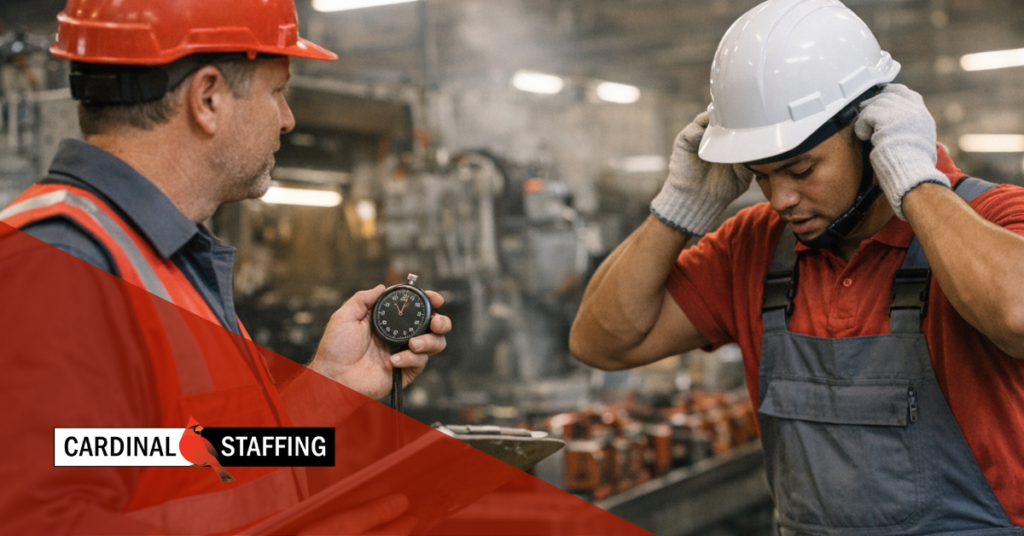
Fast Manufacturing Staffing: How Quick Placement Drives Production Goals
If you lead a manufacturing operation, you’ve faced this scenario: Your assembly line is running short-staffed on a Monday morning in May. A critical station has been empty since Friday, the person who worked it transferred to a competitor offering a faster hiring process and better onboarding. Now, your crew is rotating through coverage, quality inspections are backing up, and three orders that were supposed to ship Wednesday are going to be late. By Thursday, you’re facing penalty clauses with two customers, and your operations team is burning through overtime trying to recover lost output.
This isn’t hypothetical. If you manage a manufacturing plant, assembly operation, packaging facility, or warehouse in the Midwest, you’ve lived versions of this scenario. The gap between when you identify a staffing need and when a qualified worker actually begins productive work on your floor isn’t just an HR metric, it directly determines whether you hit your production commitments or fall short.
Most plant managers and operations directors understand that understaffing hurts throughput. What many don’t fully quantify is how much the speed of hiring compounds that impact. A role filled in two days versus two weeks doesn’t just mean 12 days of higher output; it means the difference between meeting a customer deadline or losing credibility, between absorbing seasonal surge without overtime escalation or burning out your existing crew.
The Real Cost of Unfilled Seats on Your Production Floor
Every day a position sits empty on your floor, the operational cost multiplies silently. In assembly environments, one missing station worker doesn’t just reduce that one person’s contribution, it creates a bottleneck that ripples downstream. If your line requires sequential handoffs between stations, a gap in the middle can idle workers further along who are waiting for input. Those idle workers still draw wages. The work still needs to happen. That work either compresses into shorter timelines, which raises error rates, or it extends past your planned completion window.
In packaging and warehousing operations, the math is equally unforgiving. Imagine a facility preparing for a high-volume promotional event or seasonal demand spike. You have a confirmed order for 50,000 units to ship by a specific date. Your team planned staffing at full capacity to meet that timeline. Then two pickers call in during the week before the push, or a temporary worker doesn’t show on day two, and you’re short-handed heading into peak volume. You can’t retroactively adjust the customer’s expectation. You can’t ask the retailer to delay their promotional launch. You either find replacement workers immediately or you miss the ship date, and that miss has consequences: penalty clauses with the customer, damage to your reputation, possible loss of future contracts.
Traditional hiring timelines, post a job, review applications over several days, schedule interviews, conduct multiple rounds, check references, process paperwork, onboard, were designed for roles where a few extra days doesn’t crater the business. That model doesn’t translate to production environments where workforce gaps don’t pause. Orders keep coming. Demand doesn’t wait for your recruiting process to complete.
Understanding Time-to-Fill and Why It Matters More Than You Think
Time-to-fill is straightforward in definition: the number of days between identifying a staffing need and having a qualified worker performing productive work on your floor. In practice, that metric reveals how vulnerable your operation is to change.
Consider the difference between a seven-day time-to-fill and a 24-hour placement. If you lose a worker on Monday and traditional staffing takes a week to find a replacement, you’re operating understaffed for seven working days. During peak season, seven days of understaffing might mean 5,600 units of lost capacity (assuming, illustratively, an 800-unit-per-day throughput at full staffing). If your margin on those units is $2 per unit, that’s 11,200 dollars of unrealized revenue before accounting for the customer relationship risk or the overtime costs you incurred trying to bridge the gap.
Now consider the same scenario with a staffing partner who can deliver a qualified candidate within 24 hours. You’re understaffed for one day instead of seven. The operational impact is compressed from a week of reduced output to a single-shift scramble. Your existing team doesn’t burn through overtime reserves. The customer’s order ships on time. The relationship stays intact.
The difference between one day and seven days isn’t just a 6-day improvement. It’s the difference between a manageable change and a crisis that affects customer retention, worker burnout, and profitability.
How Slow Hiring Cascades Into Missed Deadlines and Lost Orders
The chain reaction of slow hiring is predictable, which means it’s also preventable, if you understand where it starts.
Week one: A position opens. You post it internally, then externally. If you’re using a traditional job board or waiting for applications to accumulate, you’re already losing time. Candidates apply at different rates. Screening takes days. You schedule interviews for week two.
Week two: You conduct first-round interviews. Some candidates don’t show. Others aren’t suitable. You narrow the pool, schedule second interviews for week three or bring candidates back for a floor walk. Meanwhile, your production team is covering the gap with overtime or reduced shifts.
Week three: You make an offer. The candidate negotiates or asks for a start date a week out. You process paperwork, conduct background checks, and schedule orientation. Your operations timeline is now 3+ weeks removed from when the need was identified.
Week four: The candidate starts. Onboarding takes a few days. They’re not fully productive until day four or five of their first week. By the time your new hire is at baseline efficiency, a month has passed. In assembly or warehousing, that month represents thousands of units of lost capacity, shifted deadlines, customer apologies, and operational stress that cascaded across your entire team.
This timeline assumes a smooth hiring process. If a candidate withdraws, if your preferred candidate accepts an offer elsewhere, if paperwork gets delayed, you’re back at week two or three starting the search again. The compounding effect is brutal during seasonal surges when every facility in your region is hiring simultaneously and labor is already tight.
In packaging environments facing promotional timelines, this delay is catastrophic. A retail partner commits to a marketing campaign built around your product launching on a specific date. Your staffing slowness doesn’t change their launch date. It changes whether you’re part of that launch or whether the retailer moves to a supplier who can deliver on schedule. One missed promotional window isn’t just one lost order; it’s a missed opportunity for market presence, shelf space, and customer momentum that could have generated repeat business.
What Fast Placement Actually Looks Like and What It Delivers
Fast placement in production staffing means a fundamentally different hiring process, one built around the realities of manufacturing, not office HR timelines.
A 24-hour placement guarantee (or placement within one business day) requires a few key changes to how recruiting works. First, pre-screening happens before a role is posted, not after. A staffing partner who understands your operation has a talent pipeline of vetted candidates already evaluated for reliability, attendance patterns, and manufacturing floor fit. When you call with a need, they’re not starting from zero; they’re matching from a qualified pool.
Second, the interview process compresses. Instead of scheduling candidates days out and waiting for their availability, a responsive staffing partner coordinates same-day or next-morning interviews. Instead of multiple rounds, screening happens in one conversation where both the candidate and your team understand the role, expectations, and start timeline.
Third, onboarding is structured for rapid productivity. Instead of generic company orientation, training focuses on the specific station, equipment, safety protocols, and team dynamics of your operation. A new hire can reach baseline efficiency in one or two shifts rather than a week because the onboarding path is optimized for manufacturing, not adapted from office processes.
The result: a role filled in 24 hours instead of 21 days. That difference means your line recovers to full staffing before seasonal demand peaks, your overtime budget stays under control, and your customer commitments stay on track.
In a warehousing scenario facing a high-volume week, fast placement means you identify capacity gaps on Tuesday, have replacement pickers or material handlers confirmed for Wednesday, and hit your ship window Thursday without scrambling. In packaging, it means reacting to promotional opportunities without capacity constraints becoming the limiting factor. In assembly, it means one missing station worker creates a one-day change instead of a week-long cascade of compressed schedules and quality pressure.
The Revenue Impact of Keeping Production on Schedule
Fast staffing directly influences three revenue levers in manufacturing operations: on-time delivery rates, customer retention, and capacity utilization.
On-time delivery rates are often contractual. If you commit to shipping orders by a specific date and routinely miss those dates due to staffing constraints, you’re not just losing that sale, you’re losing the customer’s confidence. Retailers and manufacturers who depend on reliable supply chains don’t tolerate recurring delays. They shift volume to suppliers they can trust, and that shift is permanent.
Capacity utilization determines profitability per unit. If your line runs at 80% capacity because you’re perpetually short-staffed, every unit costs you more to produce (fixed overhead distributed across fewer units). If you maintain 95% capacity because staffing gaps are resolved quickly, your per-unit cost drops and margin improves. Over a year, the difference between chronically understaffed operations and fully-staffed operations is substantial.
Customer retention is the least visible but most valuable metric. A large customer who experiences one missed deadline might stick with you if you recover. A customer who experiences recurring delays due to consistent staffing issues will begin consolidating their volume with a competitor who can deliver reliably. That consolidation often happens silently; you don’t hear about it until the customer’s purchase order drops 30% and they reveal they’ve moved capacity elsewhere.
Consider a hypothetical scenario: a food processor running three shifts, normally at 92% capacity utilization. Because of slower hiring practices, they’re typically running one shift short-staffed by 2-3 people. This reduces overall line throughput by roughly 8%, dropping utilization to 84%. Over 50 working weeks, that 8% gap translates to tens of thousands of units of unrealized production. Even at modest margin, the revenue impact compounds quickly. More importantly, the understaffed shift is where quality incidents happen and where customer orders slip past their promised dates.
Now imagine that same processor working with a staffing partner who fills vacancies within 24 hours. Unexpected absences are covered. Seasonal ramp-ups are staffed on schedule. Capacity runs consistently at 91-93%. The processor delivers customer orders on time, maintains customer confidence, and captures the revenue associated with full-capacity operations.
Addressing the Trade-Offs: Quality and Onboarding Concerns
The valid concern many operations directors raise is: doesn’t hiring fast mean hiring less carefully? The answer is no, if you’re working with a partner who understands the difference between speed and shortcuts.
A staffing partner using human-first screening (rather than algorithm-driven keyword matching) can evaluate candidates quickly because they’re assessing the factors that actually predict manufacturing success: attendance history, reliability patterns, work ethic, and cultural fit. These can be evaluated in one conversation. Credential stacking and resume keywords take longer to verify but don’t predict retention or floor performance better than a direct conversation about a candidate’s actual work history and commitment.
The trade-off is real, though, in certain scenarios. Hiring for highly specialized roles (CNC programming, specific welding certifications, complex maintenance) may require longer lead times even with a responsive partner because the candidate pool is smaller. Similarly, hiring for roles requiring extensive background vetting or security clearance will take longer by nature. But for the majority of production roles, assembly, packaging, material handling, general warehouse, fast hiring is entirely compatible with quality screening if the staffing partner has domain expertise and a deep candidate pipeline.
Onboarding is where fast hiring firms either prove their commitment or reveal their weakness. A partner who places a candidate and disappears has optimized for placement volume, not placement quality. A partner who embeds onboarding support, follows up on the first week, and ensures the new hire reaches baseline efficiency quickly is optimizing for retention and performance. The difference is whether fast placement leads to a short-tenure hire who quits after two weeks (defeating the purpose) or a solid placement that fills the gap and potentially converts to a long-term employee.
Starting Your Conversation About Faster Hiring
If your operation experiences predictable staffing crunches during seasonal demand, if you’ve lost customers due to capacity constraints, or if you’re burning through overtime trying to bridge gaps left by slow hiring, the staffing model you’re using isn’t aligned with your operational needs.
The first step is mapping your current time-to-fill across different role categories. How many days does it take you to go from identifying a need to having a productive worker on the floor? Compare that to your peak demand windows. If your time-to-fill is 14-21 days and your seasonal surge lasts 8-10 weeks, you’re always starting the hiring process in reactive mode rather than proactive mode.
The second step is asking your staffing partner (or potential partner) about their pipeline depth, screening methodology, and onboarding support. A partner who can guarantee 24-hour placements should be able to explain exactly how they do it and what quality gates remain in place. If they can’t articulate their process, they’re prioritizing speed over sustainability.
A local staffing partner with roots in manufacturing understands that fast placement isn’t about reckless hiring, it’s about eliminating the non-essential steps in your recruiting process and front-loading the work that prevents poor matches. Contact us to discuss how your facility can move from reactive staffing during crisis windows to proactive pipeline building that keeps your production on schedule and your customer commitments secure.