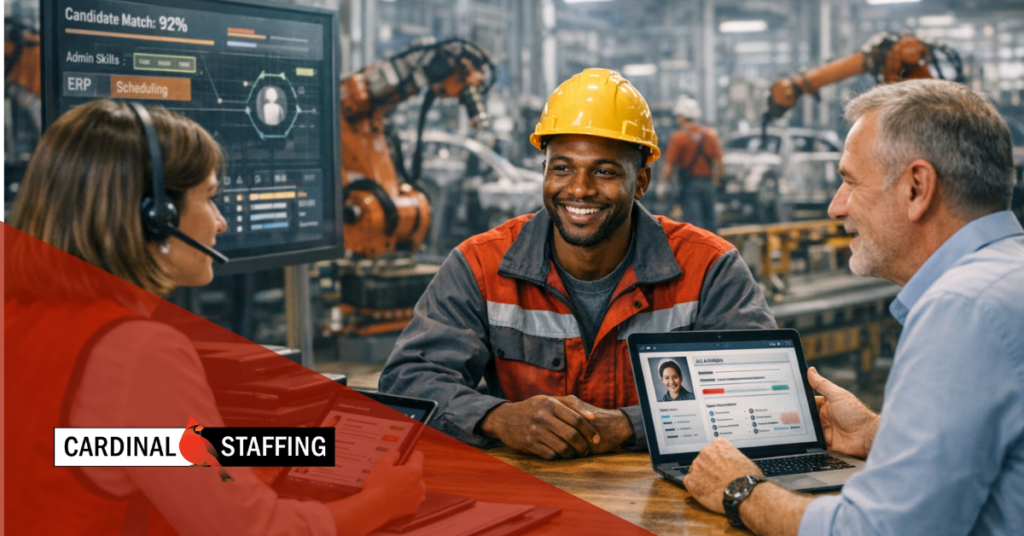
Administrative Staffing in 2026: How AI Screening Is Changing the Speed-to-Placement Game
An office manager position sits open for two weeks. Your bookkeeper is managing double duties. Data entry work piles up while you scramble to find qualified administrative staff. Meanwhile, your competitors are filling similar roles in days, not weeks. If you manage operations, oversee HR, or lead a mid-sized manufacturing or light industrial facility, this gap between your hiring timeline and theirs represents real operational cost, lost productivity, delayed reporting, and the cognitive load of understaffed back-office functions that no amount of overtime can fully solve.
In 2026, the administrative staffing landscape has shifted fundamentally. Automation and artificial intelligence now shape how agencies identify, screen, and match candidates for office manager, data entry, executive assistant, and clerical roles. The result isn’t a choice between speed and accuracy anymore; modern staffing partners who use AI-driven screening deliver both. Understanding how this technology works, and more importantly, where human judgment remains irreplaceable, helps you choose a partner who will close your administrative vacancies without sacrificing the quality of fit that determines whether a hire succeeds or creates new problems down the line.
Staffing professionals managing administrative placements consistently report that the agencies delivering the fastest placements aren’t cutting corners on quality, they’re using technology to eliminate screening bottlenecks. The competitive advantage goes to partners who combine AI efficiency with rigorous human judgment about cultural and operational fit.
Why Speed-to-Placement Has Become the New Competitive Edge in Administrative Staffing
Administrative and clerical vacancies create immediate operational friction in ways that are hard to quantify but impossible to ignore. An open office manager role means decisions about payroll, scheduling, and vendor management slow down or fall to someone without authority or context. A vacant data entry position means invoicing delays, accounts receivable gaps, and financial reporting that lags behind reality. An executive assistant absence forces leadership to spend time on calendar management and correspondence when they should be driving strategy.
Historically, hiring for these roles followed a pattern: post the job, wait for applications to accumulate, screen resumes manually over several days, schedule interviews across a window that stretched two to three weeks, then conduct final interviews and negotiations. By the time a candidate started, a month had elapsed. In 2026, that timeline has become a competitive liability. Qualified administrative professionals, particularly office managers with experience in manufacturing environments and data entry specialists with industry-specific software skills, have options. A staffing partner who can present a vetted shortlist within 24 to 48 hours wins placements. A partner still working through applications manually loses candidates to faster competitors.
The stakes are higher now because the candidate pool is narrower. Automation has raised the baseline expectations for what qualifies as competent administrative work. Software proficiency that was once a differentiator, proficiency in ERP systems, advanced Excel, inventory management platforms, is now table stakes. Accurate screening isn’t just nice-to-have efficiency; it’s the difference between filling a role with someone who adds immediate value and spending another two weeks cycling through candidates who lack critical technical skills. Speed without accuracy is chaos. Accuracy without speed is irrelevant. Staffing agencies in 2026 have no choice but to master both.
How AI Screening Tools Actually Work in Administrative and Clerical Recruitment
AI screening in administrative recruitment operates through a series of interconnected systems that work faster than any human could, while still flagging candidates for human review based on structured criteria. Here’s how the process typically flows:
When an application arrives, AI tools immediately parse the resume and application against a set of defined role requirements: required software proficiency (Excel, QuickBooks, Salesforce, manufacturing ERP systems), minimum typing speed or data accuracy benchmarks, relevant job titles and tenure, and specific experience markers like “warehouse management system” or “accounts payable processing.” Natural language processing goes beyond simple keyword matching, it recognizes that a candidate titled “Administrative Coordinator” at a food processing plant likely has equivalent experience to an “Office Administrator” at a manufacturing supplier, and it can surface that connection even if the exact job title doesn’t match.
Imagine a concrete example: a staffing team works with a light industrial supplier, let’s call them Midwest Parts Corp, to fill a data entry specialist role. Seventy-five applications arrive within a week. Manually, a staffing coordinator would need roughly 20 to 30 minutes per application to thoroughly review resume, check for gaps, assess software skills against requirements, and flag concerns. That’s 25 to 37 hours of staff time before an initial shortlist even emerges. An AI screening tool completes that same initial review in minutes, analyzing all 75 applications in parallel, scoring each candidate against the defined criteria, and presenting the coordinator with a ranked list of top-matched candidates for final human judgment. The coordinator now spends their time on deliberate decision-making, reviewing assessment results, calling top candidates to confirm availability and assess communication style, rather than administrative triage.
AI screening does not make placement decisions. These tools are expert filters, not decision-makers. AI flags, ranks, and surfaces. Trained staffing professionals still interpret those results, still conduct phone screens to assess soft skills, still make the actual placement decision. The technology removes the noise and accelerates the early funnel so that human expertise focuses where it matters most: determining whether a candidate will thrive in your specific environment.
Faster Time-to-Fill for Office Manager and Data Entry Roles
The practical impact of AI-assisted screening on time-to-fill is significant, particularly for high-volume clerical roles like data entry and for specialized administrative positions like office manager. Industry reporting and feedback from staffing partners suggests that AI screening compresses the early hiring stages by five to ten days in typical scenarios. That reduction comes from three concrete shifts:
Parallel screening instead of sequential review. A human reviewer processes applications one at a time. An AI system evaluates all applications simultaneously. If 40 candidates apply for a role, the AI completes initial screening while the first human review is still underway. The candidate shortlist emerges in hours rather than days.
Automated skills assessments integrated into the application process. Instead of asking candidates to answer screening questions in an email, modern staffing platforms embed a typing speed test, data accuracy assessment, or software proficiency quiz directly into the application. Scores arrive immediately, tied to each candidate’s profile. Staffing coordinators don’t wait for responses; they review completed assessments alongside resume data, already ranked.
Elimination of back-and-forth scheduling friction. When a candidate moves to the interview stage, AI-driven calendaring can suggest interview slots based on both the candidate’s availability and the hiring manager’s schedule, often completing the scheduling in a single automated message rather than a two-day email thread. The first interview happens sooner.
For roles like data entry clerk or administrative assistant, where time-to-fill directly impacts workload distribution and client satisfaction, shaving five to ten days off the hiring timeline translates to real operational relief. A vacancy that used to cost four weeks of productivity loss now costs two and a half weeks. Over a year, that compounds.
Beyond the Resume: How AI-Driven Matching Improves Candidate Fit
One of the most consequential shifts in administrative staffing is moving beyond credential matching to outcome prediction. Two candidates can have identical resume experience, same job titles, same tenure, same stated software skills, and perform completely differently in your role. Modern matching algorithms begin to account for that gap.
Structured assessment data reveals patterns that a resume never could. An administrative professional’s consistency across previous roles (short tenure with frequent job changes versus sustained employment with clear growth trajectory) predicts whether they’ll stay in your position for three years or six months. Communication clarity in written assessments, how they explain problem-solving approaches, how they structure responses, indicates whether they’ll handle vendor communication and executive-level correspondence effectively. Responsiveness to messages during the hiring process itself (how quickly they complete assessments, how thoroughly they answer screening questions) reflects the reliability and attention-to-detail you’re actually hiring for.
For administrative roles specifically, staffing agencies can now incorporate soft-skill indicators into pre-screening that historically required an interview to assess. A data entry specialist’s accuracy on an automated typing and data quality test is a direct proxy for job performance; a candidate who scores 98 percent accuracy will likely deliver error rates that matter to your accounting department. An office manager candidate’s written responses to scenario-based questions (how would you handle a scheduling conflict between two executives?) reveals their judgment and communication approach before they ever sit across a desk from your operations director.
More accurate matching means fewer premature placements, situations where a candidate looked good on paper, started the role, and quit after six weeks because the environment didn’t fit, or performed poorly because critical skills weren’t as proficient as stated. For employers, this reduces re-fill costs and training frustration. For candidates, it means starting roles where they’re genuinely positioned to succeed, rather than being placed in positions based on keyword matching and hoped-for fit.
Where Human Judgment Remains Essential
The risk in celebrating AI’s efficiency is overstating its role. The most successful administrative placements, ones that stick, that convert to permanent hire, that genuinely improve your operational capability, still depend on human judgment at critical moments.
An AI tool might flag a candidate as “low match” because they lack specific software experience listed as required, yet a staffing professional with manufacturing expertise recognizes that the person’s track record with similar systems means they’ll master your software in a week of onboarding. Conversely, a candidate might score high on technical criteria but come across during a phone screen as defensive or resistant to feedback, a red flag that no resume algorithm catches. A skilled interviewer hears that shift in tone and recalibrates their recommendation.
There’s also irreducible nuance in assessing cultural fit and operational realities that AI simply cannot evaluate. Your manufacturing facility might require someone comfortable with a fast-paced, direct communication style where decisions happen in morning huddles and expectations shift based on production demand. A candidate with impeccable administrative credentials might struggle in that environment if they need detailed written instructions and linear planning. A staffing partner who’s toured your facility, watched your operations, and understands your culture can flag that mismatch; an algorithm cannot.
The most effective staffing agencies in 2026 treat AI screening as a tool that amplifies human expertise, not a replacement for it. Technology eliminates manual drudgery so that experienced recruiters can focus on judgment calls, whether this person will thrive in your specific environment, whether their reliability patterns suggest they’ll be a keeper, whether their communication style aligns with your team’s dynamics. That’s where the real value of a staffing partnership lives.
What to Expect When Working with a Tech-Enabled Staffing Agency
If you’re evaluating staffing partners or preparing to work with a new agency, understanding the modern administrative recruitment process helps you assess whether they’re genuinely leveraging technology to serve your speed and accuracy needs.
First, ask how they screen candidates initially. A partner worth your time should describe a structured assessment process that moves beyond resume keyword matching. They should be able to tell you about skills testing, structured application questions, and how they use assessment data to rank candidates. If their answer is vague or sounds like traditional phone screens, you’re likely working with an agency that hasn’t modernized their screening process.
Second, inquire about their time-to-first-interview commitment. A modern staffing partner with effective AI screening should be able to offer same-day or next-day shortlists for administrative roles with well-defined requirements. If they’re saying “we’ll start screening and get back to you in a few days,” they’re not fully leveraging technology. Speed with accuracy is the point.
Third, understand their candidate assessment data. Ask what information they’ll provide about shortlisted candidates beyond a resume. Do they have typing speed scores, software proficiency test results, or communication assessments? Can they explain why they ranked one candidate above another based on objective criteria, not just gut feeling? The more transparent and data-informed their recommendations, the better you can trust the matches.
Finally, confirm that human touchpoints remain throughout the process. A staffing partner should still conduct reference checks, confirm candidate availability and expectations, and perform final phone screens to assess soft skills and cultural alignment. AI screening is a filter, not a shortcut. The candidates who reach your desk should already be vetted by a real person who understands your business and can speak to why they’re recommending a match.
Making the Right Choice for Your Administrative Staffing Needs
The competitive pressure for administrative talent has fundamentally changed what staffing agencies must deliver. Speed matters. Accuracy matters more. A partner who can combine both, leveraging AI to eliminate screening bottlenecks while maintaining rigorous human judgment about fit, will close your vacancies faster and with better long-term outcomes than agencies still running manual processes.
When you’re ready to fill an open office manager, data entry, or executive assistant role, audit how potential staffing partners approach screening and matching. Ask about their technology, their timelines, and their assessment data. Look for evidence that they’re using tools to amplify expertise, not replace it. The right partner will demonstrate that they understand your operational realities and can deliver candidates who aren’t just credentialed, they’re matched for success in your specific environment and committed to your long-term staffing stability.
If you’re managing administrative staffing gaps and want a partner who combines modern screening technology with manufacturing floor expertise, Cardinal Staffing Services has 25+ years of experience matching administrative and clerical professionals to mid-sized manufacturers and light industrial facilities across the Midwest. Their process combines structured candidate assessment with human-first evaluation to deliver qualified matches quickly. Contact them to discuss how they approach administrative staffing for your specific operational needs.